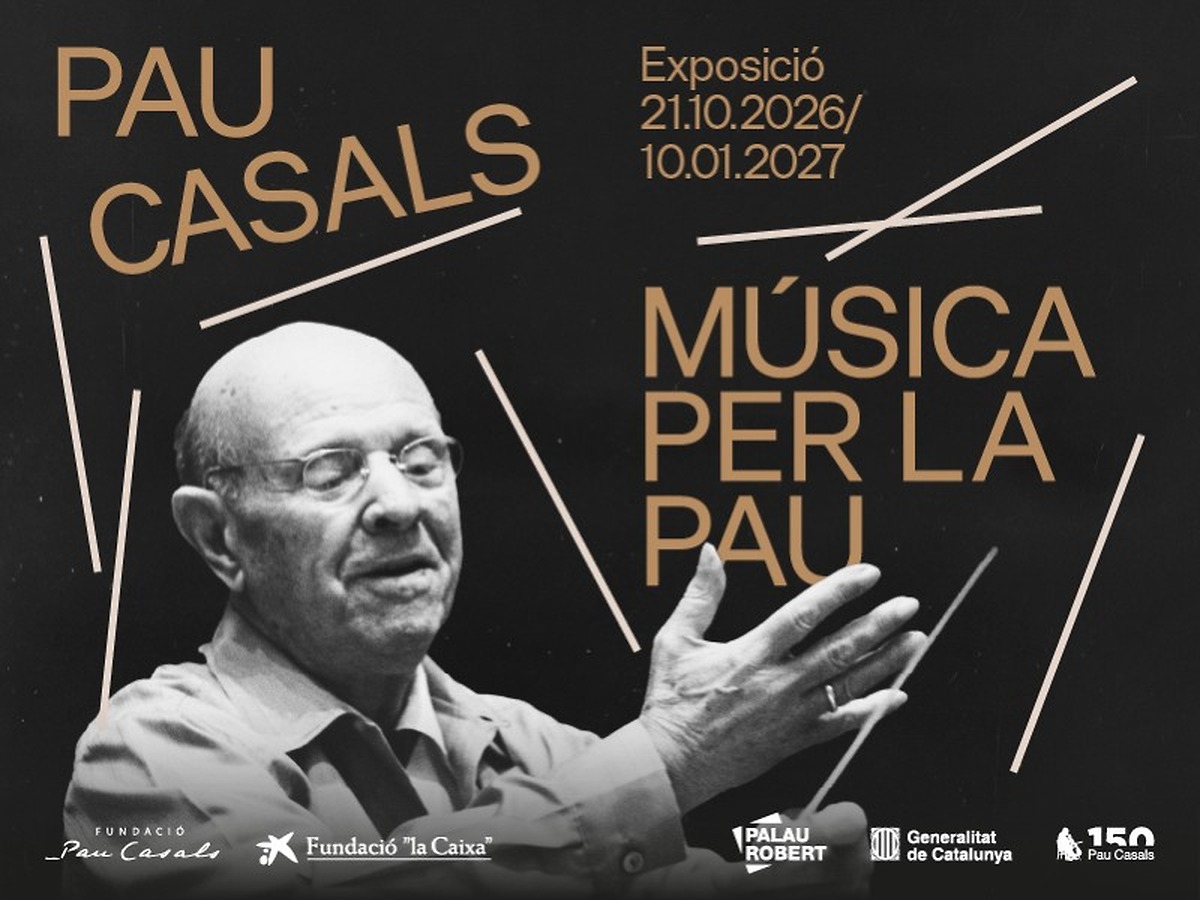
The exhibition aims to honour the figure of Pau Casals, highlighting the legacy of an artist who dedicated his work to the cause of peace. Curated by Núria Ballester, director of the Pau Casals Museum in El Vendrell, the exhibition is organised by the Government of Catalonia, along with the Pau Casals Foundation and the 'la Caixa' Foundation. It will be open to the public free of charge from 21 October 2026 to 10 January 2027.
This exhibition is part of the Year of Pau Casals, marking the 150th anniversary of his birth. Following its run in Barcelona, the exhibition will move to CaixaForum Madrid in February 2027 and then to the Pau Casals Museum in El Vendrell in June.
exhibition layout and themes
The exhibition occupies the first hall of the Palau Robert and is structured into five thematic areas. The first section introduces Pau Casals (El Vendrell 1876 - San Juan, Puerto Rico 1973) and emphasises not only his virtuosity but also his commitment to freedom, democracy, and peace.
The second section focuses on music as an art of communication, illustrating how Casals viewed the score not as a fixed document but as a living text open to new interpretations.
The third area explores music as a tool for commitment and protest, showcasing the social role of the artist. It highlights Casals' refusal to perform in countries that did not respect democratic principles, such as Soviet Russia and Nazi Germany, and his humanitarian efforts during and after World War II.
The fourth section underscores music as a message of peace, reflecting Casals' belief in music as a universal language capable of transcending political and national boundaries. His involvement with the United Nations and his nomination for the Nobel Peace Prize in 1958 are also highlighted.
The exhibition concludes with reflections from various personalities on the legacy of one of Catalonia's most universal figures. Visitors can read quotes from renowned individuals such as composer Jean Sibelius, writer Thomas Mann, and physicist Albert Einstein, among others.
educational initiatives
As part of the exhibition celebrating the musician's 150th anniversary, the youth newspaper Junior Report, in collaboration with Palau Robert and the Pau Casals Foundation, has developed an educational unit for secondary schools. This resource addresses Casals' journey not only as a universal artist but also as an ethical reference in the defence of peace and human rights. It aims to encourage critical thinking and reflection on exile and the role of art in social transformation.
The educational material will be freely accessible and permanently available on the Junior Report platform.