The rapid expansion of Chinese car manufacturers in Spain is beginning to have consequences beyond dealerships and roads. Authorised Treatment Centres (CAT), commonly known as scrapyards, are starting to receive vehicles from brands such as MG, BYD, Omoda, Jaecoo, and Chery, some of which are only two or three years old. According to an analysis by RO-DES, this situation reflects a new reality for the automotive recovery and recycling sector, which must adapt to the arrival of recently established manufacturers in the Spanish market and vehicles equipped with increasingly complex technologies.
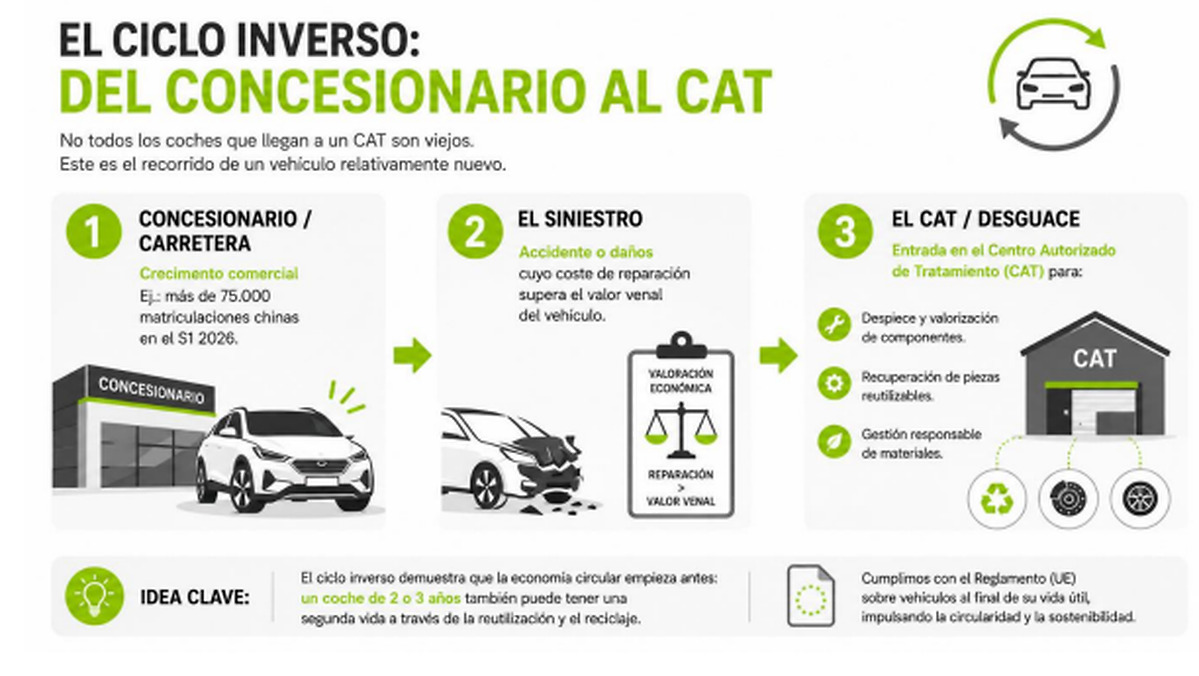
During the first half of 2026, major Chinese brands achieved 75,024 registrations in Spain, representing 12.3% of the market. MG, BYD, and Omoda & Jaecoo accounted for a significant portion of these sales, consolidating a trend that is progressively changing the composition of the national vehicle fleet.
Newer vehicles ending up in scrapyards
Traditionally, the arrival of a car at a scrapyard is associated with the end of a long useful life. However, newer vehicles can also end up in these facilities. In the case of the Chinese models appearing in CATs, their withdrawal from circulation is not necessarily due to reliability issues or aging but primarily because of severe accidents or damage where repair costs exceed the vehicle's economic value. Esteban Alabajos, director of RO-DES, stated, "We are seeing cars registered just two or three years ago entering, which was practically unthinkable until recently. In many cases, repairing is more expensive than accepting their market value, and they end up being declared a total loss." This situation presents a unique scenario: cars that still feature current technologies and relatively new components can become out of use much sooner than expected. Nevertheless, the presence of these units in scrapyards does not imply that Chinese brands have higher breakdown or accident rates; rather, their increasing presence on Spanish roads is now reflected in the market for accident vehicles.
Scrapyards face new technological challenges
The incorporation of these brands into the automotive recovery circuit poses challenges for professionals at Authorised Treatment Centres. One of the main challenges relates to the identification and cataloguing of components. Recently marketed models feature references, electronic systems, and parts that are not yet widespread in the Spanish reused parts market. For these elements to be reused in other vehicles, it is essential to correctly identify their characteristics, verify their condition, and accurately determine compatibility between models and versions. Additionally, the growing presence of hybrid, plug-in hybrid, and electric vehicles requires specific safety and treatment procedures. High-voltage batteries are among the most delicate elements, necessitating trained personnel, appropriate tools, and protocols to avoid electrical risks during decontamination and dismantling operations. New vehicles also incorporate numerous sensors, cameras, electronic control units, and advanced driver assistance systems, which can complicate the recovery process compared to traditional mechanical components. This transformation requires scrapyards to update their technical knowledge and adapt their facilities to recover materials and parts that may still have a second life.
Vehicle recycling in Spain
The phenomenon occurs in a sector that manages hundreds of thousands of vehicles each year. According to data from SIGRAUTO collected by RO-DES, in 2025, Spanish Authorised Treatment Centres managed a total of 671,675 end-of-life vehicles. However, the entity estimates that the annual volume of vehicles needing to pass through these facilities is around 750,000 units, a figure higher than that recorded in the previous year. This discrepancy highlights the importance of reinforcing collection and treatment systems and ensuring that withdrawn vehicles are managed through authorised channels.
The sector also faces an increasing diversity of models. In the same facilities, combustion vehicles over twenty years old coexist with the latest generation of hybrid and electric vehicles, as well as models from manufacturers that have only been on the market in Spain for a few years.
The importance of component reuse
The arrival of relatively new vehicles at scrapyards also opens up opportunities for recovering components that still retain a significant portion of their useful life. Engines, body elements, electronic systems, and other spare parts can return to the market, provided their condition and technical and legal conditions allow for reuse. This recovery contributes to reducing the need to manufacture new parts, decreasing raw material consumption, and limiting waste generation. In the case of electric and hybrid vehicles, the proper management of batteries and other specific components is particularly relevant due to the materials they contain and the safety requirements associated with their treatment. The recovery of these elements is part of a circular economy model that aims to extend the usefulness of materials and reduce the environmental impact of the automotive sector.
New European recycling regulations
The transformation of the Spanish market coincides with the development of a new European regulatory framework aimed at improving the circularity of vehicles and the management of cars at the end of their life. Among the proposed objectives are new requirements regarding the incorporation of recycled materials in manufacturing, including a minimum of 15% recycled plastic in certain vehicles from 2032 and 25% from 2036. These measures aim to promote resource utilisation, improve vehicle design for easier dismantling, and strengthen material recovery. For Authorised Treatment Centres, this change will necessitate combining traditional decontamination and recycling procedures with new technical capabilities adapted to increasingly electrified and digitalised vehicles.
The arrival of brands such as MG, BYD, Omoda, and Jaecoo at Spanish scrapyards thus represents a new phase for the sector. Their commercial expansion is not only changing consumer preferences but also how cars will need to be recovered, reused, and recycled in the coming years.