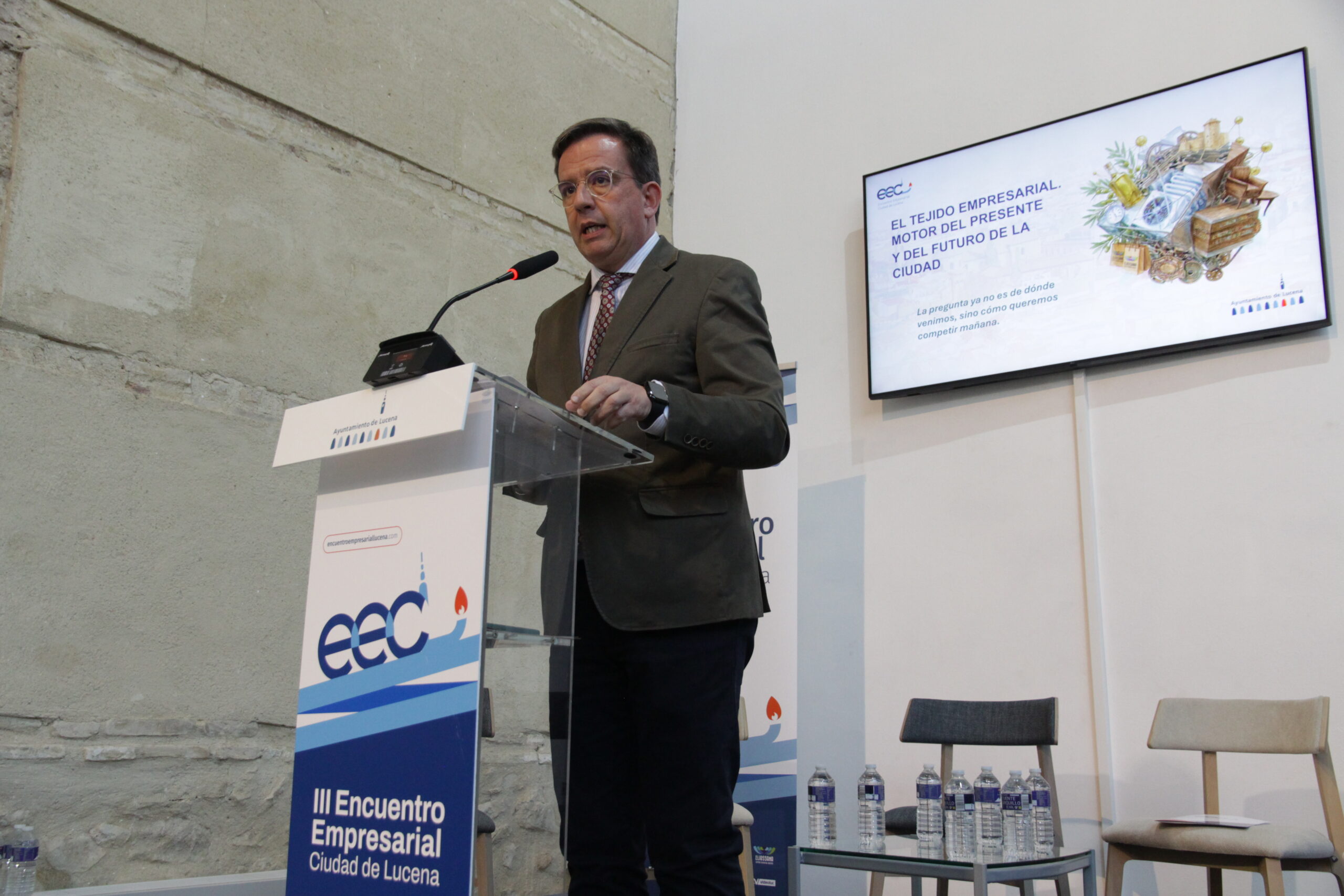
The mayor of Lucena, Aurelio Fernández, addressed the key economic challenges facing the city at the third business meeting, organised by the Eliossana Open Commercial Centre. In his presentation titled ‘Diagnosis of Lucena: present and future. Keys to progress’, Fernández emphasised the necessity of increasing the availability of industrial land, modernising industrial estates, and ensuring a reliable electricity supply to attract new investments.
Fernández presented an analysis of the local economy, highlighting its growth and diversification. According to the data shared during the presentation, Lucena is home to 3,557 businesses, representing a 16.72% increase since 2014, and has 18,712 registered members in the Social Security system, with approximately 1,500 workers commuting daily from surrounding municipalities.
The mayor underscored the competitiveness of the industrial refrigeration and wood and furniture sectors in both national and international markets, along with the contributions of agro-industry, commerce, services, tourism, and craftsmanship to local employment and economic activity.
“We cannot aspire to continue growing as an industrial city if we cannot guarantee the electricity supply that this growth requires,”
Fernández stated. He identified the future electrical substation and improvements to high-voltage lines as strategic for facilitating business expansions and new industrial and urban projects.
Fernández also called for progress on the Lucena–Puente Genil section of the Olivar motorway and urged the Spanish government to ensure safe and reliable rail connections between Andalusia and Madrid. He noted that issues with high-speed rail services also affect municipalities without a station, such as Lucena, complicating professional travel and visits from clients and suppliers.
Training was another focal point of the mayor's address. He advocated for closer collaboration between educational institutions and businesses to align vocational training with the needs of the local workforce. He also highlighted the importance of continuous training and generational change in family businesses, suggesting that digitalisation and energy efficiency should extend to small and medium-sized enterprises, commerce, and self-employed individuals.
Regarding the role of the town hall, Fernández expressed a commitment to simplifying procedures, enhancing support for businesses, and maintaining direct communication to understand their needs. “I want it to be an institution they can rely on when they have a project,” he affirmed. This commitment is linked to planning for industrial land, supporting entrepreneurship and commerce, and improving urban accessibility.
The mayor's speech was a highlight of the afternoon programme at the third business meeting, which concluded with a session titled ‘Analysis and debate with entrepreneurs’. This session featured contributions from María de la O Redondo, councillor for Innovation and Local Development; Antonio Aguilera Muñoz, president of the Virgen de Araceli Cooperative; Macarena Ruiz, CEO of Paula Orfebres; Pedro Galisteo, general director of Intarcon; Rafael Sánchez Cruz, CEO of Grupo Ruiz y Sánchez; and Vicente Briones Muriel, CEO of Toy Planet Lucena–Briones and president of the Eliossana Open Commercial Centre.