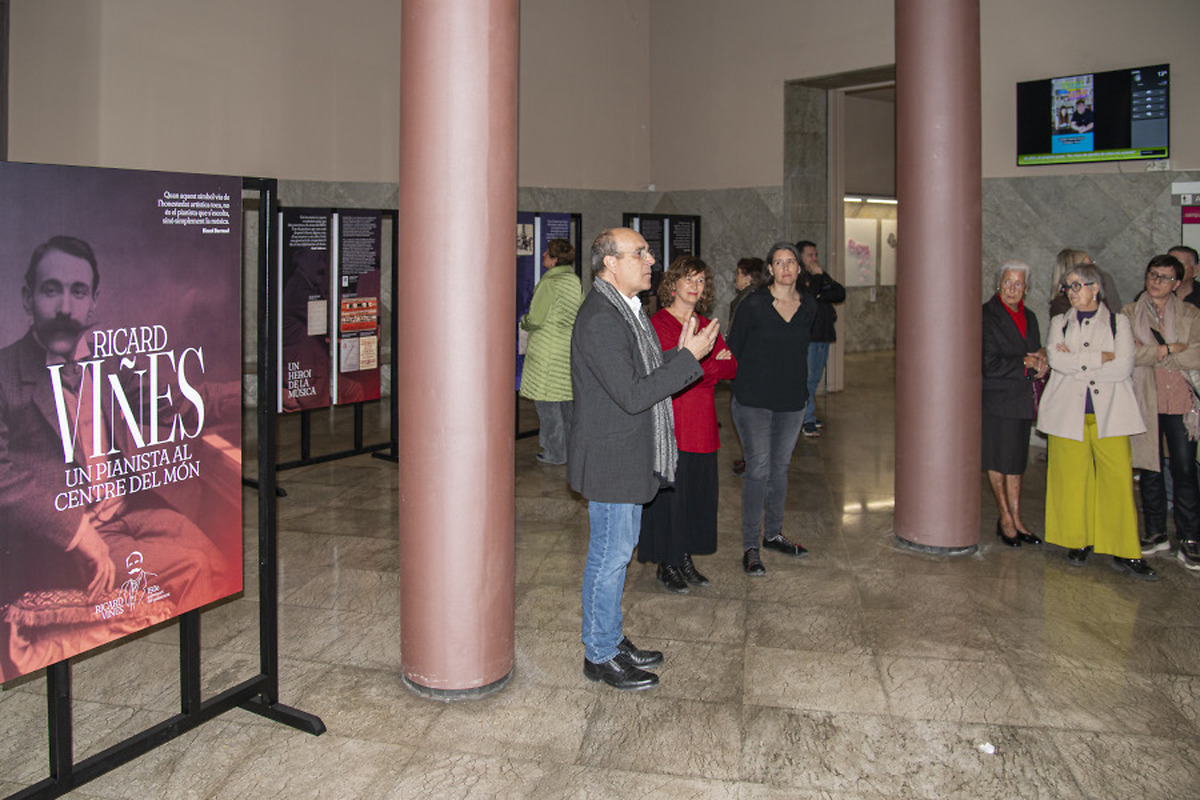
The Ricard Viñes Chair at the Universitat de Lleida (UdL) has officially launched its inaugural cultural offering, which includes an exhibition and a dramatized concert. The exhibition, titled Ricard Viñes: a pianist at the centre of the world, opened today in the Rectorate lobby and will be available for viewing until 10 February.
This initiative marks the first cultural proposal from the Ricard Viñes Chair, established in May with support from the Diputación de Lleida to promote the legacy of the renowned musician from Lleida. Curated by UdL professor Esther Solé, the exhibition showcases the life and work of Viñes through various panels featuring reproductions of materials primarily sourced from the documentary archive deposited at UdL in 2019. These include photographs, sheet music, and concert posters, along with a series of QR codes that provide audio recordings of Viñes performing or speaking.
The second cultural production from the Chair, titled Ricard Viñes, memory of a pianist, is a dramatized concert set to premiere on 5 November at the Gran Teatre de la Passió in Cervera. This performance, written and directed by Ferran Farré, is part of the Aulas de Extensión Universitaria programme and is supported by the Institut d'Estudis Ilerdencs and the UdL's Vice-Rectorate for Culture. The cast includes actors Fèlix Pons and Queralt Albinyana, with composer Albert Guinovart performing the entire repertoire on piano and debuting a composition dedicated to Viñes in front of a full theatre. "It will be a show that combines music, projections, and interpretations in a dreamlike and poetic tone," highlighted Núria Casado, the Vice-Rector for Culture.
These two initiatives are the first steps in a more ambitious project, the Viñes Memorial, which aims to periodically commemorate the musician's legacy through publications, conferences, and recordings. One such recording is planned for next April, featuring all of Viñes' works for voice and piano, as explained by Màrius Bernadó, the Chair's director and UdL professor. "It is time to start transferring academic work into cultural products aimed at a broad audience," he stated.