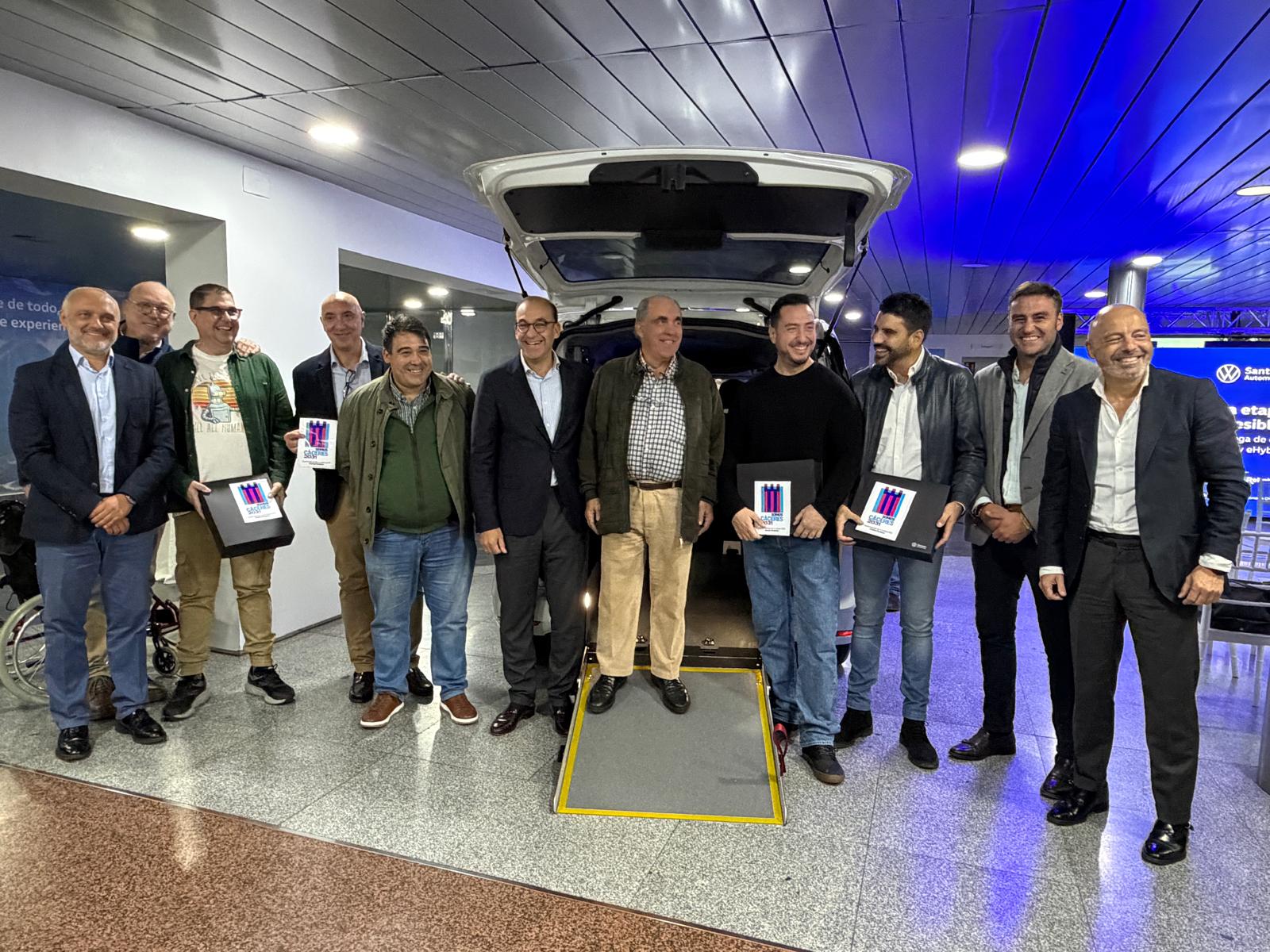
Cáceres has expanded its fleet of accessible taxis with the introduction of five new adapted vehicles, bringing the total number of taxi licences in the city to 80. The new taxis, which will begin service on Friday, were unveiled during a ceremony attended by Mayor Rafa Mateos and other local officials.
The event took place at the Volkswagen Santano Automoción dealership located in the Las Capellanías industrial estate. Alongside the mayor were Pedro Muriel, the councillor for Public Services and Mobility, Jorge Suárez, the councillor for Commerce, and representatives from Santano Automoción and Rehatrans, the company responsible for the adaptations.
With the addition of these five new licences, Cáceres now has 80 municipal taxi licences, 14 of which are adapted vehicles, representing 17.5% of the total. This figure significantly exceeds the minimum requirement of 5% established by regulations. Mayor Mateos highlighted the importance of this expansion in improving essential public services for citizens, stating, "From the very beginning, we were aware that there was a need to enhance the service, as there was demand and a necessity to increase the fleet of vehicles in our city."
Features of the new vehicles
The newly introduced taxis are Volkswagen Caddy Maxi eHybrid models, specifically adapted to facilitate access for individuals with reduced mobility. Each vehicle can accommodate five passengers and one wheelchair user. The adaptations made by Rehatrans comply with UNE 26494 standards for accessible taxis and include a lowered floor to meet the required interior height of 1.40 metres, as well as a lightweight, foldable EasyFlex rear ramp that optimises boot space when not in use.
Additionally, the vehicles feature a step at the right sliding door for easier access, handrails for passengers with mobility challenges, and approved retention systems for both wheelchairs and their occupants. These plug-in hybrid vehicles also incorporate more efficient propulsion technology, contributing to the modernisation and sustainability of the taxi service.
Mayor Mateos expressed gratitude to Santano Automoción and Rehatrans for their efforts in delivering the vehicles on schedule, and highlighted the importance of supporting local businesses to enhance services for the community. He also acknowledged the role of taxi drivers as ambassadors of the city, noting that their vehicles not only transport local residents but also the many tourists visiting Cáceres.
Support for cultural initiatives
During the event, the mayor announced that the new taxis, along with other public service vehicles in the city, will display stickers supporting Cáceres' bid to become the European Capital of Culture in 2031. Mateos explained that this initiative aims to engage all sectors of the local community in a collective project. "The European Capital of Culture project is not just Rafa Mateos' project, nor is it solely the project of the Cáceres City Council; it is a project for every single citizen of Cáceres, a project that originates in the city for all of Extremadura," he stated.
Cáceres is currently among the four finalist cities for this designation, and the mayor encouraged continued efforts to demonstrate that "culture is the path and that culture is the transformative element of society that we need in these challenging times."
The introduction of these five vehicles concludes a process initiated by the City Council to expand municipal taxi licences, all designated for adapted vehicles. This measure followed a year of monitoring and evaluation of the service, along with discussions with various representatives from the sector. The new licences were awarded through a public competition, ensuring principles of transparency, equality, and fair competition.