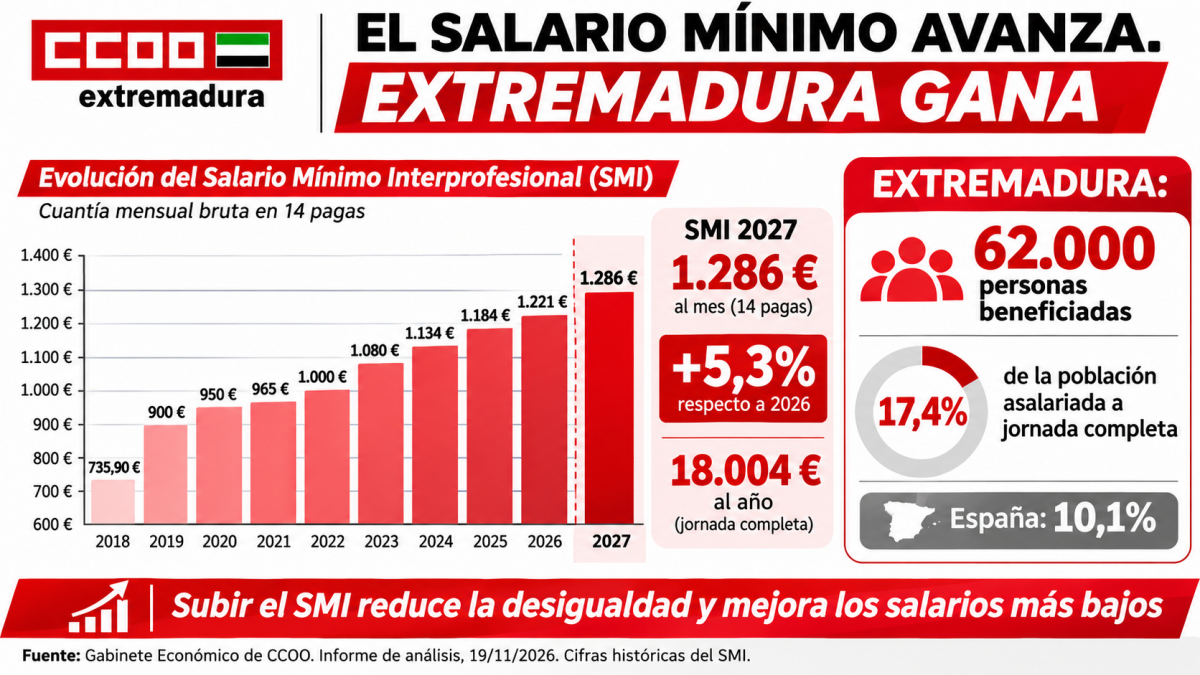
According to estimates from the Economic Confederation of CCOO, the increase in the minimum wage (SMI) will affect 17.4% of the salaried population in extremadura. This figure positions extremadura as the second autonomous community with the highest incidence of minimum wage increases, following the canary islands.
The minimum wage is set to rise by 5.3%, bringing it to €1,286 per month in 14 payments by 2027, which equates to €1,500 in 12 monthly payments and an annual salary of €18,004 for full-time work.
For CCOO in extremadura, this increase represents a significant advancement in a region where salaries are among the lowest in the country, and a considerable portion of the workforce is employed in sectors with lower remuneration. The union emphasises that salary improvements should extend to all workers through collective bargaining. The minimum wage increase cannot replace salary hikes in collective agreements, as it is essential to also raise the wages of those earning above the minimum wage, especially in a context of strong corporate profits.
CCOO highlights that the high incidence of the minimum wage in the region is linked to the structure of its labour market, characterised by sectors with relatively low pay. The report identifies agriculture, livestock, hospitality, commerce, and certain services as the sectors where minimum wage increases have the most significant relative impact.
The union warns that the 5.3% increase in the minimum wage will only help maintain and improve purchasing power if it is effectively incorporated into salaries and not offset by compensation mechanisms and salary supplement absorption.
In recent years, minimum wage increases have been a crucial tool in combating precariousness, improving families' purchasing power, and advancing towards a fairer distribution of wealth. CCOO reminds us that economic growth and positive business results should also translate into better wages for workers, particularly in areas like extremadura, where it is essential to progress towards wage convergence with the rest of the country.
One of the main positive effects of the minimum wage increase is its contribution to reducing gender inequalities. According to the confederal report, 60% of those benefiting from the minimum wage increase in Spain are women, while 40% are men. This data reflects the higher female presence in occupations and sectors with lower wages and confirms that minimum wage improvements have a particularly significant effect on reducing the gender pay gap.
The report also highlights that the minimum wage has a particularly high incidence among young people, who are more likely to earn below-average salaries. Specifically, 21% of the salaried population aged 16 to 24 will benefit from the minimum wage increase, while this figure is 12% for those aged 25 to 34. However, CCOO cautions against viewing the minimum wage solely as a protection for those entering the labour market for the first time. In fact, 66% of those benefiting are aged between 35 and 65, demonstrating that the minimum wage serves as a salary guarantee for a significant portion of the adult population.
CCOO in extremadura stresses that the minimum wage increase not only represents a direct improvement for the 62,000 beneficiaries but can also have positive effects on the regional economy. Raising the wages of low-income workers enhances household purchasing power and can stimulate economic activity, particularly in commerce and services. The union believes that improving wages is also a way to strengthen social cohesion, reduce economic inequalities, and move towards a more balanced growth model. Furthermore, wage improvements contribute to strengthening social contributions and the sustainability of the public social protection system.