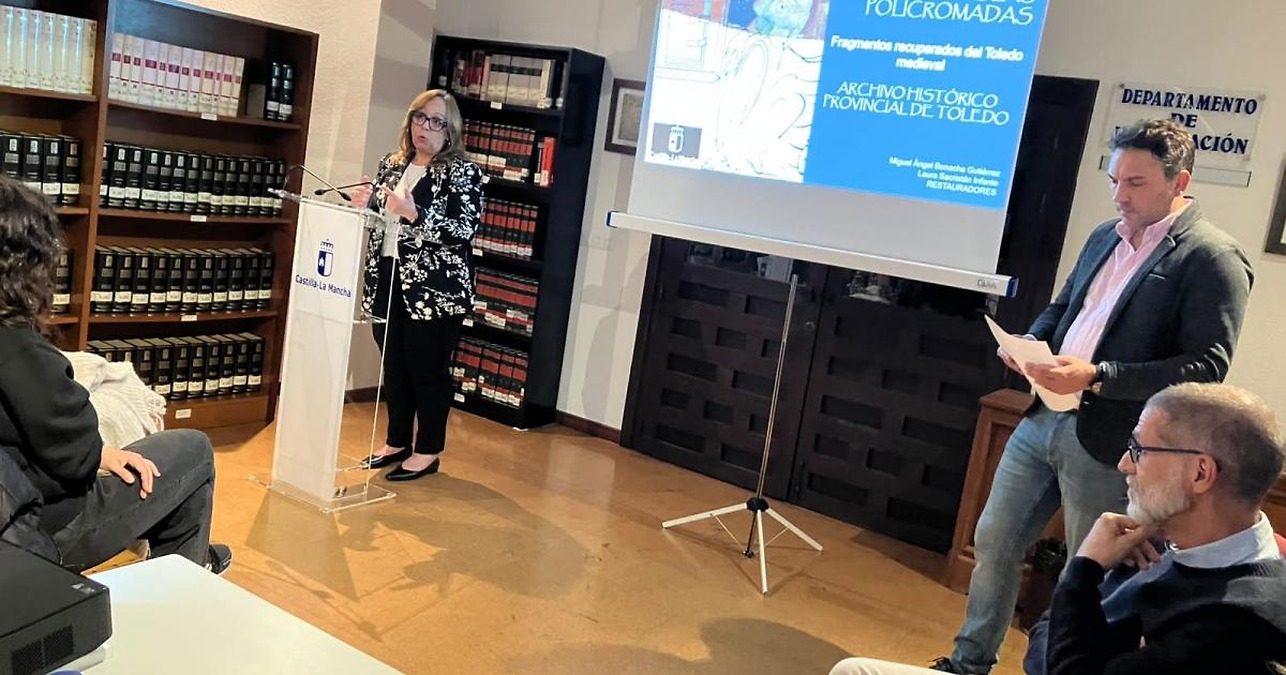
The Government of Castilla-La Mancha has underscored the importance of historical archives as spaces for preserving collective memory, research, and knowledge dissemination during the first session of the conference series 'A glance at the past', held at the Provincial Historical Archive of Toledo.
Carmen Teresa Olmedo, the Deputy Minister of Culture and Sports, participated in this initiative aimed at bringing various aspects of history, archaeology, and cultural heritage closer to the public through encounters with researchers, specialists, and professionals in these fields.
“Archives are much more than places where documents are stored. They are custodians of our collective memory, witnesses of history, and essential tools for understanding who we are and how we have come to be,”
Olmedo stated during her address. She also highlighted the importance of making historical knowledge accessible to society, emphasising that “research reaches its true dimension when it transcends the academic sphere and is shared with the public.”
The 'A glance at the past' series aims to foster dialogue and knowledge exchange between specialists and the general public, offering new perspectives on the past and contributing to a better understanding of shared heritage.
The first conference, titled 'Polychrome tables: recovered fragments from medieval Toledo', was presented by restorers Miguel Ángel Bonache Gutiérrez and Laura Sacristán Infante, who discussed the historical and heritage significance of these pieces.
The series will feature approximately one conference per month, excluding summer months, and will take place on Tuesday afternoons in the research room of the Provincial Historical Archive of Toledo.
Olmedo also reminded attendees that Castilla-La Mancha is home to five provincial historical archives, one in each province, whose documentary collections are essential sources for historical and genealogical research.
She concluded by thanking the specialists and professionals involved in this initiative and inviting the public to engage with these spaces of knowledge and reflection on historical heritage. “Archives not only preserve documents; they safeguard the traces of those who came before us and allow each generation to engage with its past to better understand its present and build its future,” she remarked.