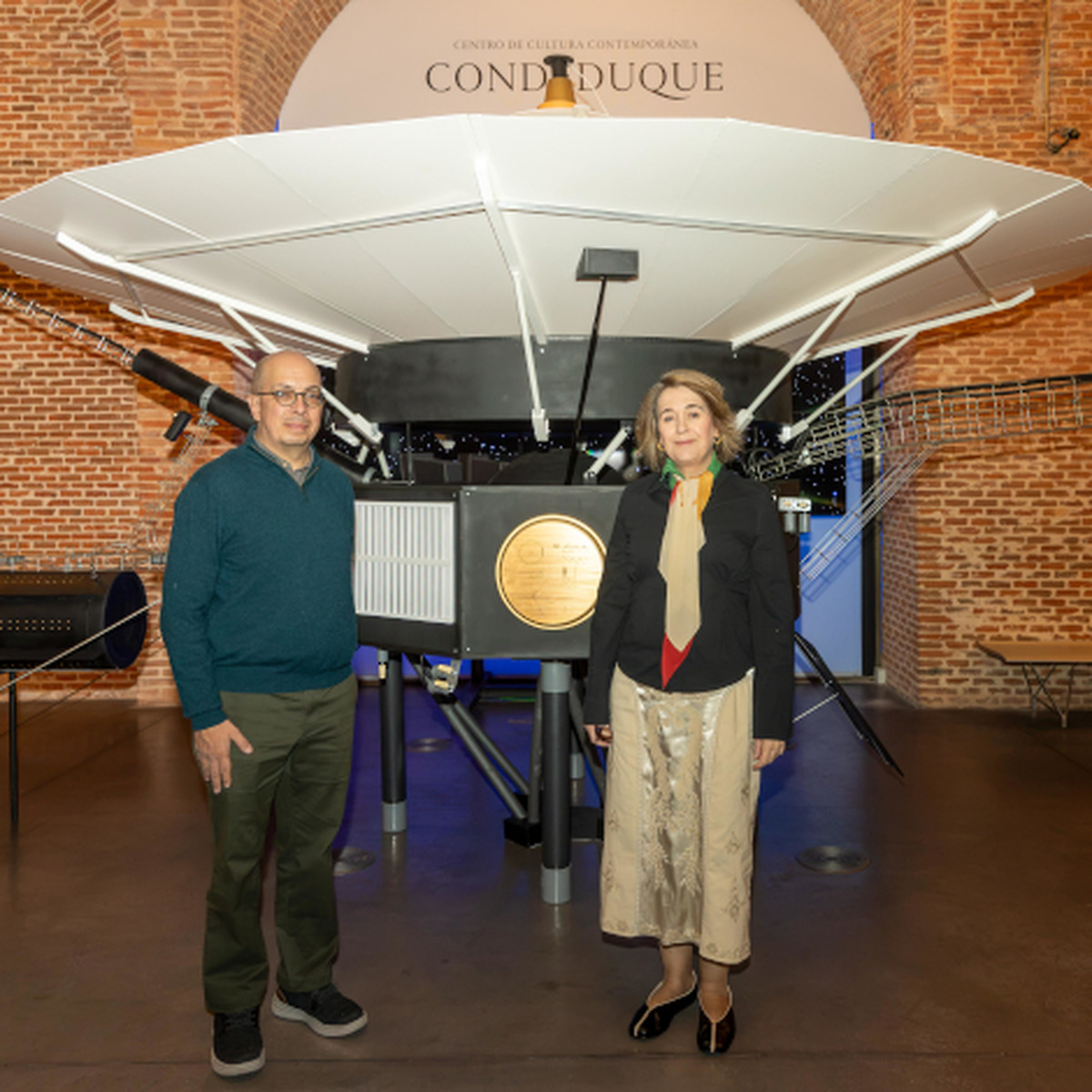
Contemporánea Conde Duque, a cultural space in Madrid, is hosting an exhibition featuring a real-size model of the Voyager 1 spacecraft until 18 November. This exhibition commemorates the 50th anniversary of Voyager 1's launch.
During her visit, Marta Rivera de la Cruz remarked that the exhibit “reminds us that curiosity and knowledge have no borders.” She emphasised that bringing this model to the people of Madrid serves to inspire vocations, share knowledge, and demonstrate that culture and science are complementary ways to understand our world and our place in the universe.
The exhibition precedes the festival ‘A day light: science and music for the Voyager 1’, scheduled for 18 November. This event will include discussions and two concerts, coinciding with the day the spacecraft will be one light day away from Earth—a distance of nearly 25.9 billion kilometres, four times the distance from Earth to Pluto.
Launched by NASA in 1977, the Voyager spacecraft were designed to explore the outer planets of the Solar System and interstellar space beyond the Sun's heliosphere. In 1990, Voyager 1 captured the iconic image of Earth as a tiny pale blue dot, and in 2012 it crossed the heliopause, becoming the first human-made object to leave the Solar System. To communicate our existence to potential extraterrestrial civilisations, the spacecraft carries a golden record containing images, music, and sounds representing various cultures of the world.
The Voyager programme is regarded as one of the most significant milestones in the history of space exploration. The images sent back by Voyager 1 and its twin, Voyager 2, of the giant planets and their moons have forever changed our perception of space. Even today, 50 years after its launch and with outdated technology, Voyager 1 continues to send back information from beyond the confines of the Solar System.
The model of Voyager 1 was constructed at the Astronomy Classroom in Armilla, Granada, as a tribute to this mission. It is a full-scale reproduction made over five years using recycled materials such as wood, plastic, cardboard, PVC, and polypropylene. The only other full-scale model of these spacecraft can be found at the National Air and Space Museum in Washington, D.C. The Jet Propulsion Laboratory (JPL) of NASA built another model, which was last displayed in 2018.