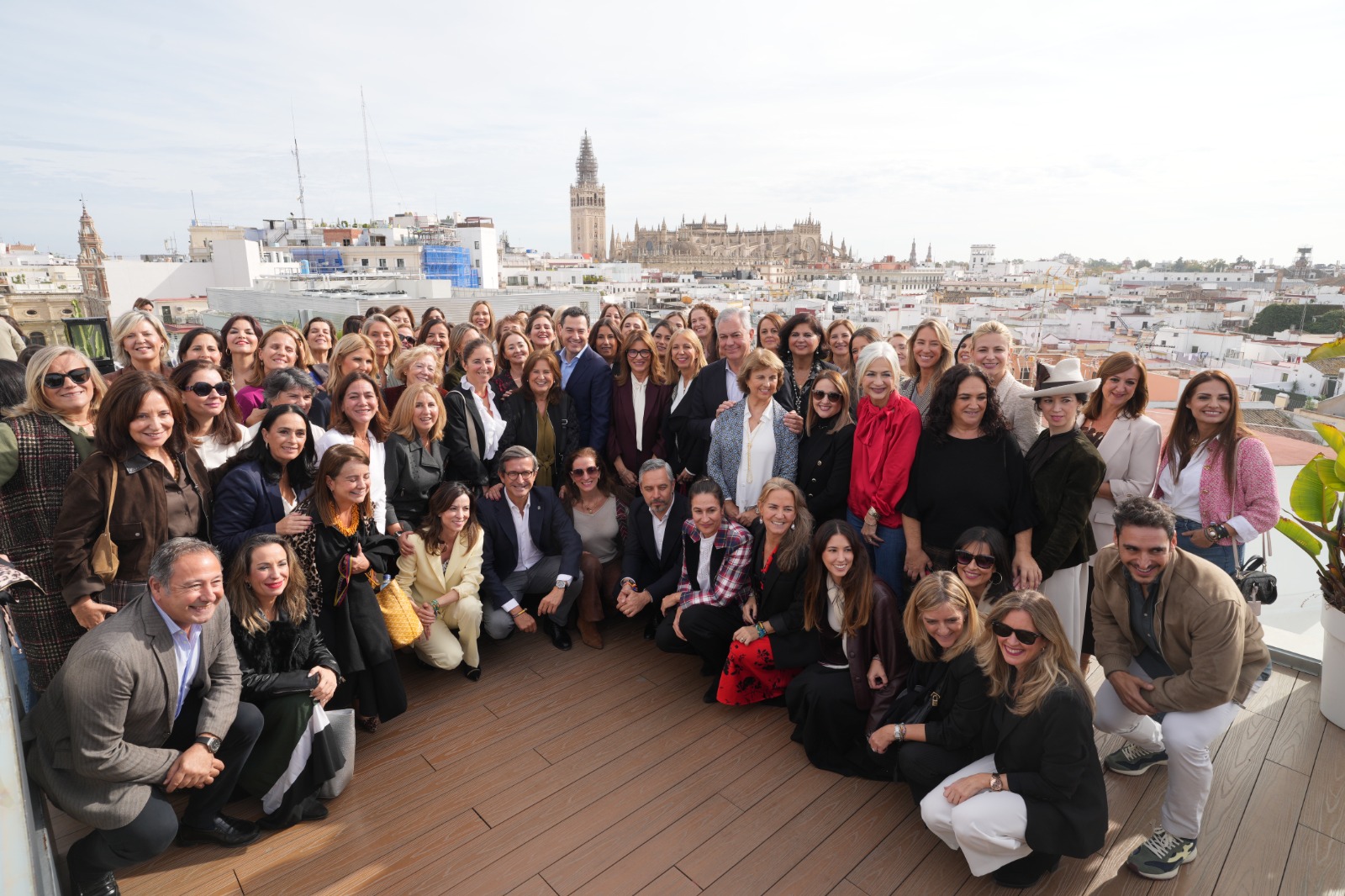
Juanma Moreno, the president of the People's Party (PP) in Andalusia, underscored the crucial role of women in the economic development of the region during a recent gathering in Seville. He highlighted progress in female entrepreneurship, women's integration into the workforce, and their representation in leadership positions within businesses.
At the event, attended by prominent local figures including Juan Bravo, the PP's candidate for Congress in Seville, and Seville's mayor, José Luis Sanz, Moreno advocated for the economic model developed in Andalusia. He stressed the need to continue advancing towards a more competitive economy with increasing female participation.
Moreno expressed gratitude to the five businesswomen present at the discussion, praising the talent, leadership, and unique perspectives that women bring to the economy, particularly in sectors where they are well represented. He also acknowledged the reforms initiated by the mayor of Seville and commended Bravo's efforts during his tenure as Minister of Finance, which laid the groundwork for enhancing Andalusia's competitiveness.
Investment and economic stability
The Andalusian PP leader identified legal security and trust as essential conditions for attracting investment and fostering business activity. He stated, "Security, let’s not change the rules of the game halfway through the match," and noted that Andalusia has recently achieved a record in foreign investment. He emphasised that businesses require a stable regulatory framework to develop their projects.
Moreno pointed out that seven years and nine months ago, Andalusia was considered a "fiscal hell," whereas it now ranks among the regions with the lowest tax pressure. He estimated that tax reductions have saved residents €2.1 billion, funds that have remained available to the people of Andalusia rather than being collected by the regional government.
Encouraging female entrepreneurship
Moreno also highlighted the administrative simplification and the Project Acceleration Unit, an initiative developed during Bravo's tenure, which has served as a model for several other regions. He cited the expedited procedures for a laboratory installation during the pandemic as an example of its effectiveness.
He lamented the lack of collaboration from the Spanish government in implementing reforms reliant on national legislation and expressed optimism that this would change after the upcoming elections on 29 November. Moreno reiterated that Alberto Núñez Feijóo aims to make Andalusia a model for Spain through favourable taxation, reduced bureaucracy, and enhanced investment opportunities.
Shifting entrepreneurial mindset
Moreno remarked on the cultural shift in entrepreneurship within Andalusia, noting that a decade ago, many young people aspired to become civil servants rather than entrepreneurs. He asserted that this mindset is changing significantly, with Andalusia now leading Spain in the number of self-employed individuals, surpassing Catalonia and Madrid.
He particularly emphasised the growth of entrepreneurship in rural areas, where starting a business entails taking on responsibilities and advocating for less bureaucracy, lower tax pressure, and better conditions for business operations. While acknowledging that many entrepreneurial initiatives struggle to establish themselves, he noted that others have successfully grown into small and medium-sized enterprises, contributing to the region's economic fabric.
Support for women in business
Moreno outlined measures aimed at facilitating women's entry into entrepreneurship, including zero quotas and financial support related to childbirth, adoption, and fostering, which previously posed challenges for maintaining business activities. He also mentioned specific employment and training programmes, such as "Preparadas" and "Alma Mujeres," which provide guidance and support, particularly for women who are victims of gender-based violence in both urban and rural settings.
He highlighted that some beneficiaries have successfully launched their own businesses after overcoming significant personal challenges. In terms of work-life balance, he referenced financial assistance of up to €7,200 per contract for self-employed individuals with children under three, along with incentives for replacing self-employed women during pregnancy-related risks and parental leave.
Progress and future challenges
Moreno provided statistics reflecting the progress made, noting that the percentage of women in high-level business roles has reached 40%, three points above the national average of 37%. According to the "Women in Business 2026" report, the proportion of female CEOs in Andalusia stands at 24%, compared to the national average of 18.5%. He also reported that there are currently 227,000 female entrepreneurs and self-employed individuals, an increase of 42,000 since the end of 2018, and that the region has 323,000 more women in employment than it did at that time.
Regarding the gender pay gap, Moreno stated that it has decreased from nearly 25% in 2018 to 16% in 2024, the most recent year for which data is available, representing an eight-point reduction. He acknowledged that there is still much work to be done but expressed confidence that progress is being made.
New growth engines
Moreno advocated for attracting new industrial investments to Andalusia, citing the establishment of the Swiss aerospace company Pilatus in Seville as a significant achievement. He recounted the extensive negotiations required to secure this project, emphasising its importance for strengthening the aerospace sector, creating higher-paying jobs, and supporting the growth of auxiliary businesses.
He also mentioned ongoing negotiations with Ryanair as an example of the international competition to attract investments, asserting that these projects are the result of years of effort and collaboration. "No economy can survive, nor can it sustain public services without a strong and capable business sector," he stated, reiterating the need to expand Andalusia's productive capacity.
Moreno highlighted the importance of tourism and the agri-food sector, both of which are vital activities that must continue to be strengthened alongside the growth of industry and the digital economy. He noted that one-third of Andalusia's economic growth comes from industry and pointed to the advancement of renewable energy production, which he linked to meeting 73% of the region's energy needs. He estimated that the digital economy accounts for approximately 21% of the regional GDP.
With 262,000 companies registered with Social Security, of which 58,400 are in Seville, Andalusia surpasses Madrid, although it still trails behind Catalonia. However, he acknowledged that a key challenge ahead is increasing the size of Andalusian companies, as many remain small and need to grow to strengthen the economic structure.
Looking ahead with Feijóo
In closing, Moreno asserted that the efforts made by Andalusia and Seville to enhance their economies, generate wealth, and increase their capacity for progress now allow them to stand on equal footing with Madrid, Catalonia, and the Basque Country. He expressed satisfaction that Andalusia exports more to Catalonia and the Basque Country than it imports from them.
Moreno lamented that this economic transformation has not received support from the Sánchez government, arguing that growth could have been even greater with a central government willing to collaborate with Andalusian administrations. He stated, "I would be satisfied with a government that makes a call and has someone on the other end of the line to manage things," before highlighting the opportunities that a government led by Alberto Núñez Feijóo could create by working in tandem with the Seville City Council and the Andalusian government to generate employment and wealth.
Finally, Moreno called on the women present at the meeting, noting that they represent approximately 52% to 53% of the population and play a vital role as leaders and role models in their respective professional and social spheres. He stated, "Women are absolute prescribers," and reiterated the importance of their contributions to the economy. He urged entrepreneurs to collaborate ahead of the 29 November elections to build a broad social majority and asserted that a future government must include experienced and capable individuals to manage effectively. "The PP must be the backbone of that government," he concluded, extending his gratitude to all women working in rural, agricultural, industrial, business, and social sectors, whose contributions he deemed essential for the development of both Andalusia and Spain.