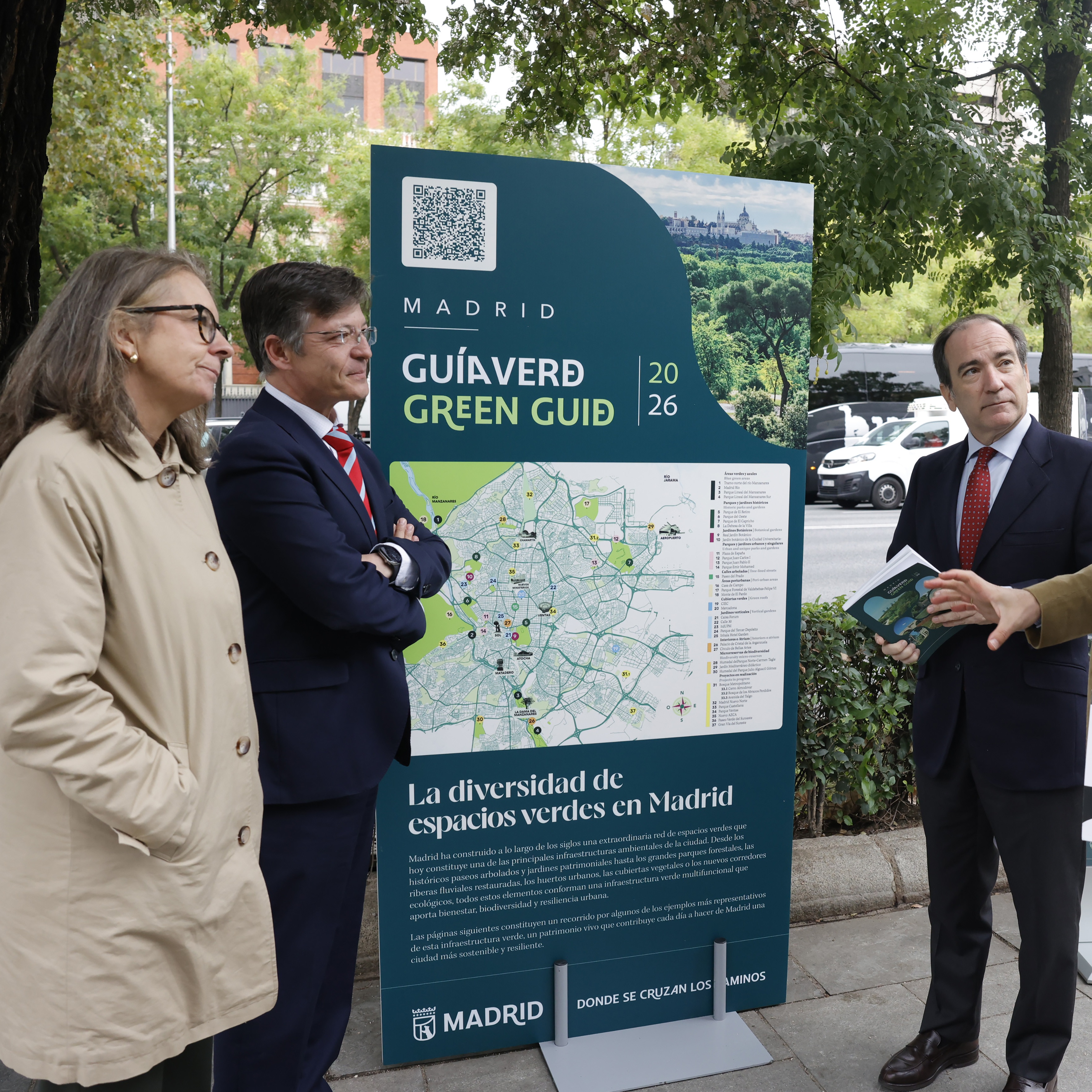
The Green Guide of Madrid has been unveiled, featuring 36 notable spaces and initiatives designed to enhance the city's green and blue infrastructure. This publication, presented by Borja Carabante, the delegate for Urban Planning, Environment and Mobility, includes six strategic projects currently underway, ranging from historic parks and urban forests to green roofs and river restoration efforts.
Available in both Spanish and English, the guide aims to highlight the capital's green and blue infrastructure and its contributions to biodiversity, climate resilience, and quality of life. During a visit to the Paseo de la Castellana, Carabante showcased the city's oldest street tree, a protected elm that is nearly 200 years old, believed to have been planted around 1830. This elm is one of the key features of the Green Guide, which invites residents and visitors to explore Madrid's natural heritage and understand how green infrastructure contributes to a healthier, more sustainable, and resilient city.
The guide, developed as part of the Madrid 360 Environmental Sustainability Strategy, offers insights into various spaces and initiatives, including the Southwest Green Walk, the Metropolitan Forest, Madrid Nuevo Norte, Castellana Park, and the Gran Vía del Sureste. These projects reflect Madrid's evolution towards an urban model where nature plays an increasingly vital role in sustainability, ecological connectivity, and citizen well-being.
By showcasing both well-known natural sites and lesser-known initiatives, the guide combines a look at the city's established heritage with examples of new environmental solutions, positioning Madrid at the forefront of sustainable capitals. The bilingual edition will help promote this heritage beyond Spain, facilitating its dissemination among international delegations visiting Madrid and tourists through information offices.
The publication was created in collaboration with specialists and organisations dedicated to the study of Madrid's green heritage, including the Global Network of Green Infrastructure, the Polytechnic University of Madrid, the Royal Academy of Engineering, Crea Madrid Nuevo Norte, Madrid Calle 30, the Canal de Isabel II, and the Juan XXIII Foundation. The Environmental Education Department of the Madrid City Council and professionals from various municipal units also contributed.
With a print run of over 2,000 copies, the guide includes maps to locate the featured spaces and projects, as well as additional content accessible via a QR code. The bicentennial elm on the Paseo de la Castellana stands as a living testament to the city's evolution and its tradition of tree-lined walks. Standing approximately 18 metres tall, with a trunk circumference of 3.8 metres and a canopy diameter of around 14 metres, this tree is protected as a singular tree under Madrid's General Urban Planning Plan of 1997.
Historically, elms have played a significant role beyond mere decoration. Their broad canopies provide shade and comfort, while their presence in public squares has fostered community gatherings. In Madrid, their importance was particularly notable; in 1849, the Geographical and Statistical Dictionary of Spain and its Overseas Possessions by Pascual Madoz recorded 13,341 elms in the city's streets, accounting for 37.1% of the urban tree population at that time.
However, the spread of Dutch elm disease, an Asian-origin illness that killed over a million elms in Spain, drastically reduced their presence in the urban landscape. Nevertheless, research and genetic improvement efforts have opened new possibilities for their recovery. This year marks the 40th anniversary of the Elm Genetic Improvement Programme, an initiative that has identified and recovered disease-resistant specimens. Collaboration between the City Council and the Polytechnic University of Madrid has advanced the conservation of the species, allowing resistant elms to gradually re-enter the urban environment.
As Carabante emphasised, the elm on the Paseo de la Castellana symbolises the continuity of a natural heritage that has endured through Madrid's transformations, linking its landscape history to new environmental challenges. This aligns with the dual perspective of the Green Guide, which encompasses both the natural spaces that have accompanied the city's growth and the projects shaping its future, with nature as an essential element for enhancing the quality of life for its inhabitants.