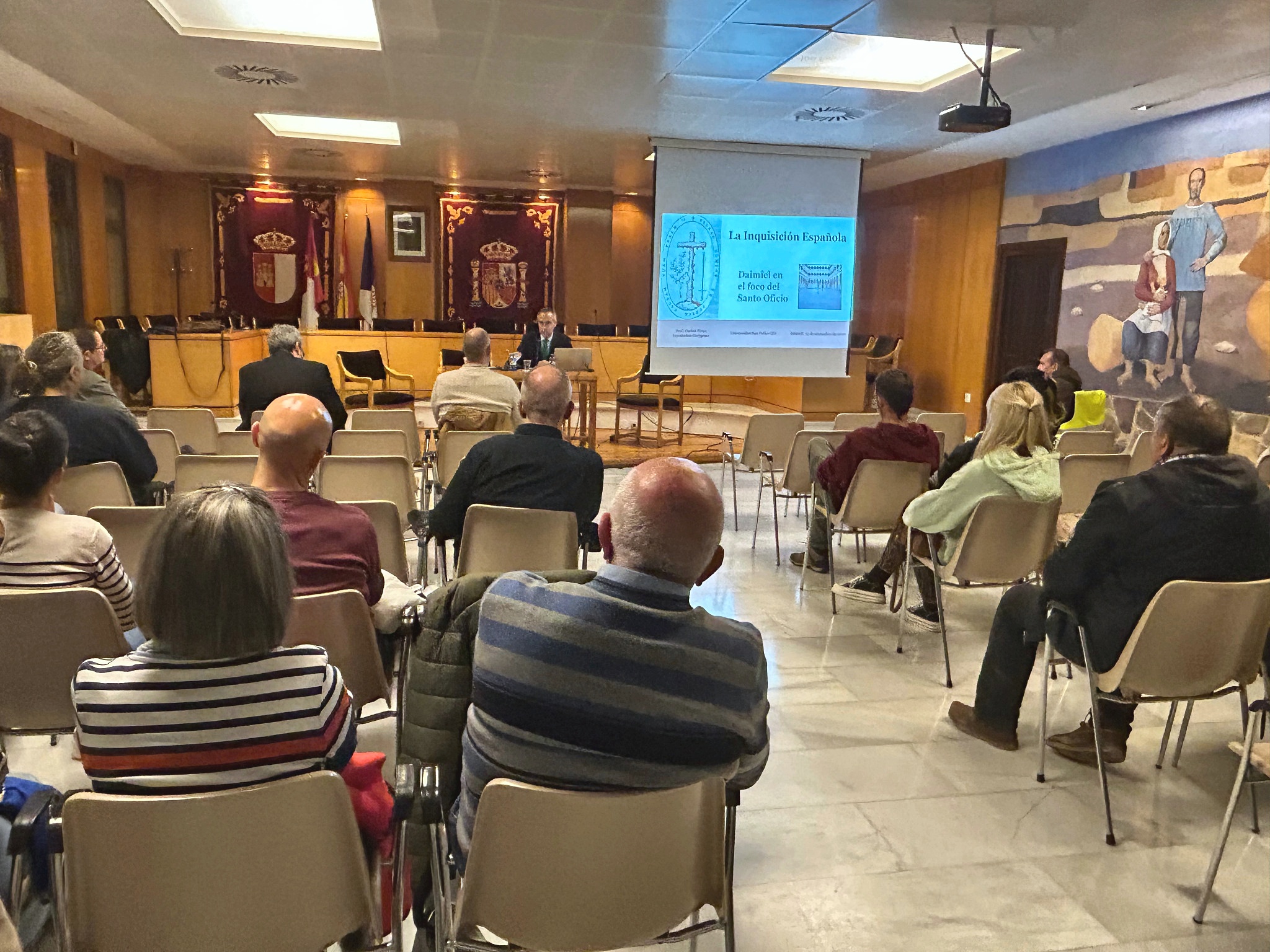
The thirteenth edition of ‘Daimiel Pueblo de Brujas’ began on Friday with two lectures aimed at shedding light on the historical realities behind some of the most well-known episodes of witchcraft and the Inquisition. The sessions took place in the plenary hall of the Town Hall, featuring presentations by Carlos Pérez Fernández-Turegano, a professor of the History of Law and Institutions at CEU San Pablo University, and Roberto Morales Estévez, a doctor of Modern History from the Autonomous University of Madrid.
Both speakers offered complementary perspectives, aiming to dismantle preconceived notions and bring the audience closer to the documents and circumstances that shaped the witchcraft narrative. Pérez opened the series with a discussion on the origins, organisation, and functioning of the Spanish Inquisition, established in 1478. He detailed the structure of the Holy Office and focused on the district court of Toledo, which included Daimiel, examining a specific case: the inquisitorial process against Manuel Carrillo Albornoz, an 18th-century priest from Daimiel. This investigation illustrated the various phases of a real procedure and addressed misconceptions surrounding the use of torture and judicial practices of the Inquisition.
The second lecture shifted focus while maintaining the aim of questioning inherited narratives. Morales discussed ‘The factory of fear: the invention of the witches' sabbath and the conspiracy of witches’, concentrating on how the myth of the sabbath was historically constructed and how certain beliefs became widely accepted as truths. He also referenced cinema as a tool to approach a reality that lacks direct photographic representation. Morales linked this discussion to Daimiel, home to the only documented case of a witches' sabbath within the jurisdiction of the Toledo Inquisition. He highlighted the Inquisition's reluctance to acknowledge the existence of such sabbaths and conspiracies, suggesting that the image of witches often stemmed from humble women using natural remedies and traditional knowledge to survive.
These two lectures provided a fresh perspective on Daimiel's identity as a ‘Pueblo de Brujas’ and marked the beginning of an eventful weekend. The evening activities included nocturnal theatrical visits to the National Park of Las Tablas de Daimiel, which showcased one of the event's most recognisable attractions, immersing participants in a setting where nature, history, and fiction intertwine. Culinary experiences were also part of the day's offerings, with the ‘Tapas de Brujas’ route featuring nine local establishments. This initiative invites visitors to explore Daimiel through flavours and dishes inspired by the theme, available until Sunday afternoon.
The programme continues on Saturday with a schedule that combines heritage, participation, nature, and gastronomy. Activities in Plaza de España will include the ‘Humedales en Resonancia’ project, featuring initiatives such as a collective cauldron for infusing plants. In the afternoon, a live Cluedo set in the 17th century will take place at the Civic Centre of Carmen. The evening will see the return of theatrical visits and themed dinners at participating restaurants, while the ‘Tapas de Brujas’ route continues to invite locals and visitors to enjoy the local cuisine. The thirteenth edition of ‘Daimiel Pueblo de Brujas’ thus extends throughout the weekend, offering more than just the recreation of legends; it is an opportunity to discover the heritage of Daimiel, its gastronomy, and partake in activities outside of the usual tourist periods, as highlighted by Jesús Pozuelo, president of the Tourist Association of Tablas de Daimiel, during the event's inauguration.