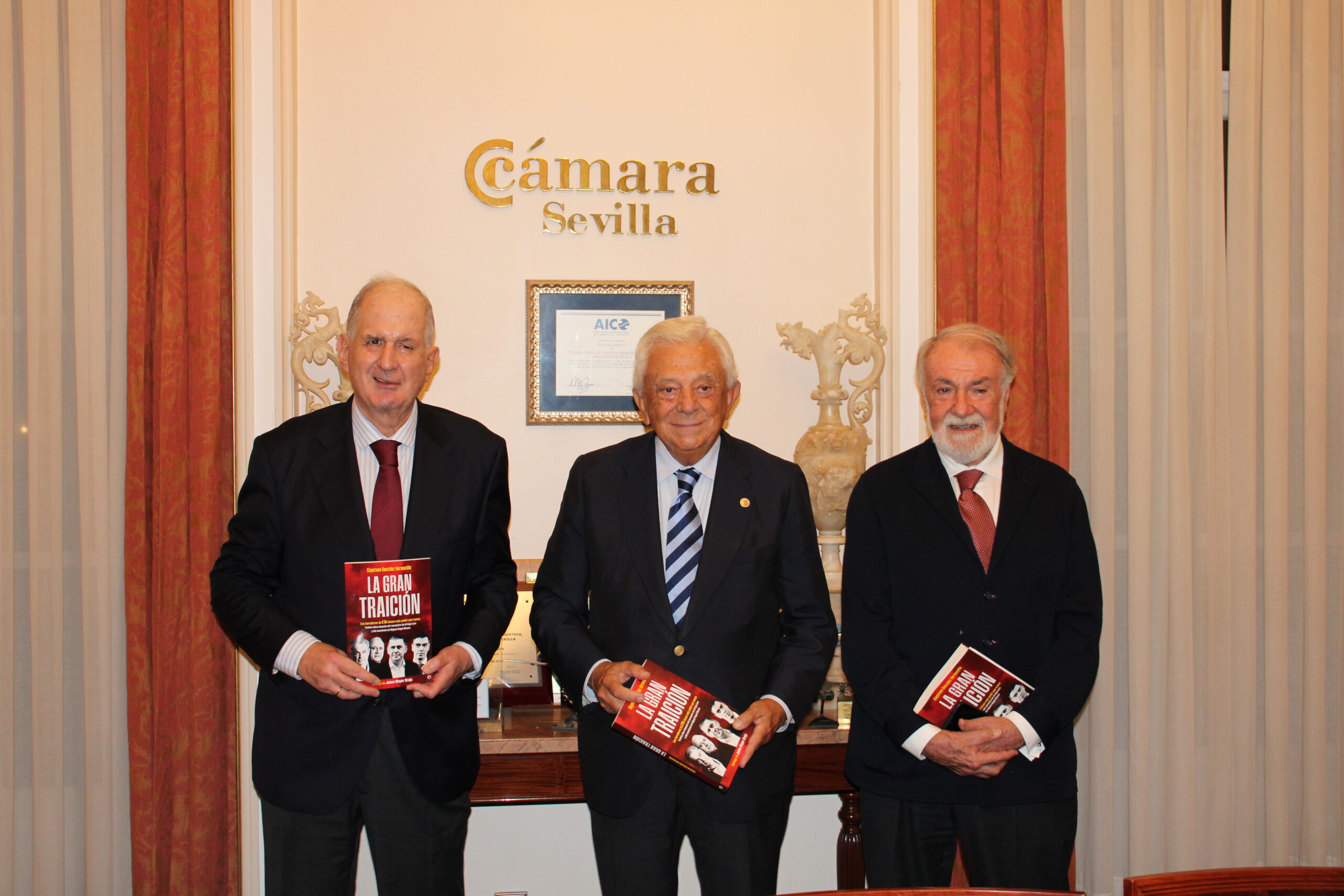
The Fundación Cámara de Sevilla recently held the launch of 'La gran traición', a book by Cayetano González Hermosilla, who served as the Director of Communication and Institutional Relations at the Ministry of the Interior from 1996 to 2001. The event was presented by Cristóbal Cervantes.
During his speech, González Hermosilla paid tribute to the victims of the Basque separatist group ETA in Sevilla, mentioning individuals such as Alberto Jiménez-Becerril and Ascensión García, as well as Lieutenant Colonel Antonio Muñoz Cariñano. He stressed the importance of remembering those from Sevilla who were murdered across Spain, stating, 'It is only right to remember them.'
Driven by a 'sense of moral duty', González Hermosilla expressed his desire to portray 'what I saw and lived through in order to defend the TRUTH - in capital letters. It is necessary to recover the memory of the victims of terrorism.'
He was joined by Jaime Mayor Oreja, who served as Minister of the Interior during González Hermosilla's tenure and is currently the president of the political party NEOS. Mayor Oreja remarked, 'The nature of ETA must first be understood. It is the worst expression of the worst Spain. It represents the dark side of Spain, the civil war, the hatred that needs to kill. Ultimately, it seeks to destroy a social and democratic order.' He also noted, 'ETA has not changed its nature, but its strategy: it no longer kills.'
Regarding 'La gran traición', Mayor Oreja described it as 'the best account of what happened in the Basque Country. Cayetano serves the TRUTH by accurately and faithfully explaining what occurred during those 12 days between the release of Ortega Lara and the murder of Miguel Ángel Blanco.'
The presentation also featured a poignant account from José Ignacio Ustaran, whose father was killed by ETA when he was just 13. Ustaran recounted, 'That was, in every sense, a tragedy. The minutes passed quickly, and our home filled with people. When he was killed, I didn't need to be told. I knew just from my mother's scream.'
Ustaran expressed his sorrow that 'to this day, victims feel incredibly abandoned by institutions' and thanked González Hermosilla for his remembrance. He shared that his mother, who was present at the event, 'worried greatly about our ability to build our lives and fought hard for us to live in peace with ourselves and without hatred. That is the most important thing.'
In response to Ustaran's testimony, González Hermosilla highlighted, 'The victims of terrorism are the best and noblest part of our society. Their story is one of 853; if we had the opportunity to hear them all, we would see how terrorism has disrupted their life projects.'
Looking ahead to 29 November, the author called for a commitment to 'not forget the unforgettable', a sentiment echoed in the closing pages of 'La gran traición'. The book serves as both a political and moral analysis that stirs consciences, while also acting as an essential exercise in memory seeking answers.
González Hermosilla poses critical questions: how is it possible that, on the 30th anniversary - set to be marked in July 2027 - of Miguel Ángel Blanco's death and Ortega Lara's release, Bildu can assume governance in those communities? Who has collaborated to bury the memory of the victims for political gain? Where does Spanish society, particularly Basque society, stand three decades later?
As a journalist who was on the front lines of the fight against terrorism, González Hermosilla recounts those years of violence and disgrace, exposing the plans executed by the Basque Nationalist Party (PNV) - which former leader Arzallus described as misguided but, at heart, patriotic - as well as the political negotiations with the group by former Prime Minister José Luis Rodríguez Zapatero and current Prime Minister Pedro Sánchez, who has been accused of legitimising ETA's political wing. For these two socialist leaders, such plans are part of a more ambitious agenda: the dismantling of the constitutional Spain established in 1978.
However, these pages also serve as an essential tribute to the victims: 'They are the best of our society, its noblest part, whom we must never forget. It is our duty to defend their dignity and demand, alongside them, that justice resolves the pending cases.'
Cayetano González Hermosilla, born in León in 1954, is a journalist who spent twenty years working in various media outlets in the Basque Country. From 1996 to 2001, he was appointed Director of Communication and Institutional Relations at the Ministry of the Interior, witnessing both the release of prison official José Antonio Ortega Lara and the kidnapping of Miguel Ángel Blanco. He also founded and directed the International Observatory of Victims of Terrorism at the CEU-San Pablo Foundation, leading the organisation of International Congresses on Victims of Terrorism in Spain, Colombia, and France. Additionally, he coordinated the book 'Gritos de Libertad: 15 voces contra el terror de ETA y la hegemonía nacionalista', published in 2004.