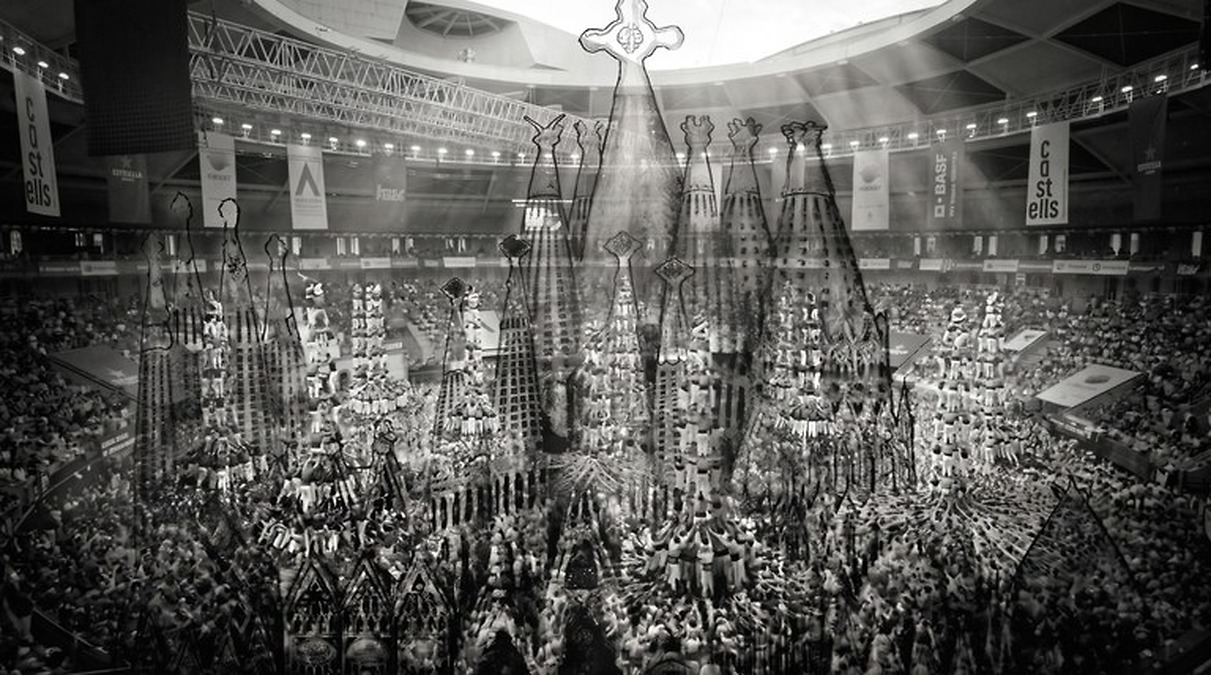
The xxx Castells Competition served as the backdrop for a unique tribute to Antoni Gaudí, marking the centenary of his death. Artist Jordi Abelló, in collaboration with Gerard Gil and Chema Novell, created 'La Sagrada Família del pueblo', an artistic project that transforms the castells built during the event on 4 October at the Tarraco Arena into the towers of Gaudí's temple.
The result is a one-minute audiovisual piece that encapsulates the entire day of castells and concludes with a single black-and-white photograph, symbolically depicting the Sagrada Família rising among the castells of the participating groups.
This project originated from a conversation between Abelló and Xavi Gonzàlez, the director of the Castells Competition, where the artist proposed a challenge that was simple to explain yet difficult to realise: to capture the entire competition in one photograph. In an event where thousands of photographs are taken, Abelló aimed to condense the entire day into a single image. He sought to transcend the competition, scores, and rivalries between groups, offering an artistic and symbolic perspective on the casteller tradition.
Abelló found inspiration in the writings of architect Cèsar Martinell, a disciple of Gaudí, who documented the master's admiration for the castells of the Xiquets de Valls and the similarities he identified with the towers of the Sagrada Família. In his book 'Gaudí y la Sagrada Família', Martinell recounts various episodes that highlight Gaudí's interest in the castells and the parallels he observed with the temple's towers. He noted that Gaudí once argued that the figures of saints depicted in the stained glass of the Sagrada Família could resemble the Xiquets de Valls. The architect perceived a profound symbolic connection: just as in a castell, individuals rely on one another to rise higher, so too does humanity need the assistance of others.
Martinell also observed that the shape of the Sagrada Família's towers followed similar principles of balance to those of the castells. With Gaudí's permission, he presented graphs demonstrating this coincidence, to which the master expressed satisfaction in confirming his principles of balance in a construction as popular and genuinely Catalan as the castells. Martinell recalls that Gaudí had found in the Xiquets de Valls a living expression of the architectural principles he applied to the temple's towers.
One hundred years after Gaudí's death, Abelló revives that connection and transforms it into a new artistic work: if Gaudí saw the castells in the towers of the temple, now the castells become the Sagrada Família. For Jordi Abelló, this project is also a personal tribute to Gaudí, coinciding with the centenary of his death. This emotional connection with the architect lends meaning to a work that aims not only to reproduce the forms of the Sagrada Família but also to reclaim his understanding of architecture, structures, and the relationships between people.
'La Sagrada Família del pueblo' offers a different perspective on the Castells Competition. For a few hours, the Tarraco Arena transforms from merely a venue for a casteller competition into a symbolic space for collective artistic creation. The castells of the various groups, typically associated with rivalry and final rankings, become part of a single monumental construction. Each structure contributes to raising a common work that is only possible through the participation of all. The proposal thus highlights the shared values of the casteller tradition: cooperation, collective effort, trust, and the ability to reach greater heights with the help of others.