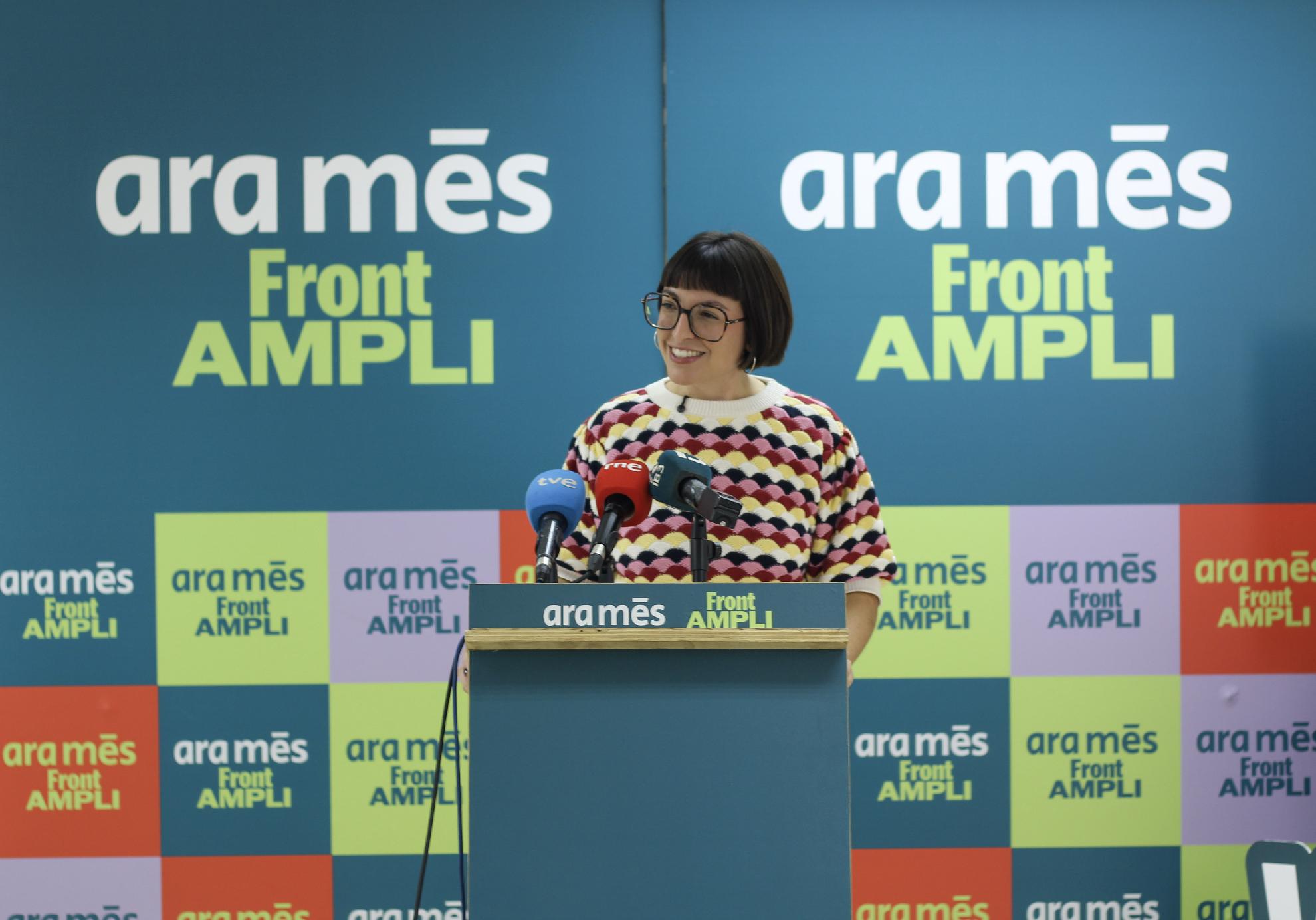
aramés–front ampli has presented its proposals to diversify the economy of the Balearic Islands, focusing on supporting local businesses and creating stable, quality jobs. Carme Gomila, the coalition's candidate for Congress, emphasised the need to invest in new productive sectors that can generate future opportunities and gradually reduce reliance on tourism.
To achieve this, the coalition is proposing the establishment of two investment funds: one public capital fund to support businesses in strategic sectors, and another that allows families to voluntarily invest their savings in productive projects and earn returns.
"The Balearic Islands have talent, businesses, and many future opportunities. What we need is to help them grow and create conditions for our young people to have good jobs and develop their life projects here. We cannot continue to depend almost exclusively on tourism," Gomila stated.
Public investment for quality jobs
The first proposal involves creating a public capital fund that, alongside private investment, would enable the launch, consolidation, and growth of companies in sectors such as agri-food, industry, new technologies, renewable energy, and culture. The aim is to support economic activities that generate stable jobs with good wages and high added value, while also helping to revive sectors that have lost significance in the islands' economy.
"We want public resources to also help an agri-food company expand production, a local industry modernise, or an innovative project become a business that creates jobs. We must invest in what allows us to have a stronger economy with more opportunities for all," Gomila explained.
Encouraging local investment
The second proposal is to create a remunerated public investment fund that offers families the option to voluntarily allocate part of their savings to business projects in the Balearic Islands, with the goal of achieving returns while contributing to the development of the productive economy. This instrument would channel investments towards local businesses and sectors with growth potential, providing an alternative to real estate investment.
"We want to open new opportunities for savings to contribute to the growth of our businesses. Making investment in the future of the Balearic Islands an attractive option will help generate economic activity and jobs," Gomila asserted.
Reviewing the special regime
The third measure proposed by aramés–front ampli is to review the Special Regime of the Balearic Islands (REIB) to eliminate incentives that favour tourism monoculture and redirect public benefits and resources towards activities that contribute to economic diversification.
"The Special Regime should compensate for the disadvantages of living on islands and help us build a more balanced economy. It makes no sense to continue incentivising a tourism model that has reached its limit while other productive sectors need support to thrive," Gomila pointed out.
Economic growth without improving quality of life
The coalition highlighted that the Balearic Islands have seen a rise in annual tourist numbers from five million forty years ago to nearly twenty million today, while sectors such as agriculture and industry have lost significant economic weight. The primary sector, which represented over 8% of GDP in 1970, now accounts for less than 2%. Meanwhile, industry has decreased from 13.7% to 5.5%, with the services sector now making up nearly 88% of the economy.
Despite strong economic growth over recent decades, this has not translated into equivalent improvements in the population's well-being. Between 2000 and 2023, the GDP of the Balearic Islands grew by 44%, but real GDP per capita increased by only 0.7%.
"We have seen significant growth in tourist numbers, but not in quality of life. It is becoming increasingly difficult to access housing and make ends meet. Our goal is not merely economic growth but ensuring that this growth translates into better living conditions for the people who live here," Gomila stated.
Gomila also cited the closures of companies such as AGAMA, PIEMA, and s'Esplet as examples of the challenges faced by productive sectors that require more support.
In conclusion, Gomila asserted that the Balearic Islands have the capacity to build a more balanced, sustainable economy with greater opportunities. "For too long, we have been led to believe that we can only live off tourism. But we have agriculture, industry, culture, talent, and the capacity for innovation. We want an economy that allows us to live well, live here, and have a future at home. There is an alternative to tourism monoculture, and aramés–front ampli has the proposals to make it possible," she concluded.